
Vimstead Forma · Functional prototype 0.1.0
Plan production with a record of what actually happens
Forma helps teams plan an order’s operations, estimate their duration and record the work as it happens. It is designed for manufacturing, assembly and repair teams that need to follow an agreed job through to a checked result.
Operation plans · Work progress · Actual time
Product specification (PDF) ↓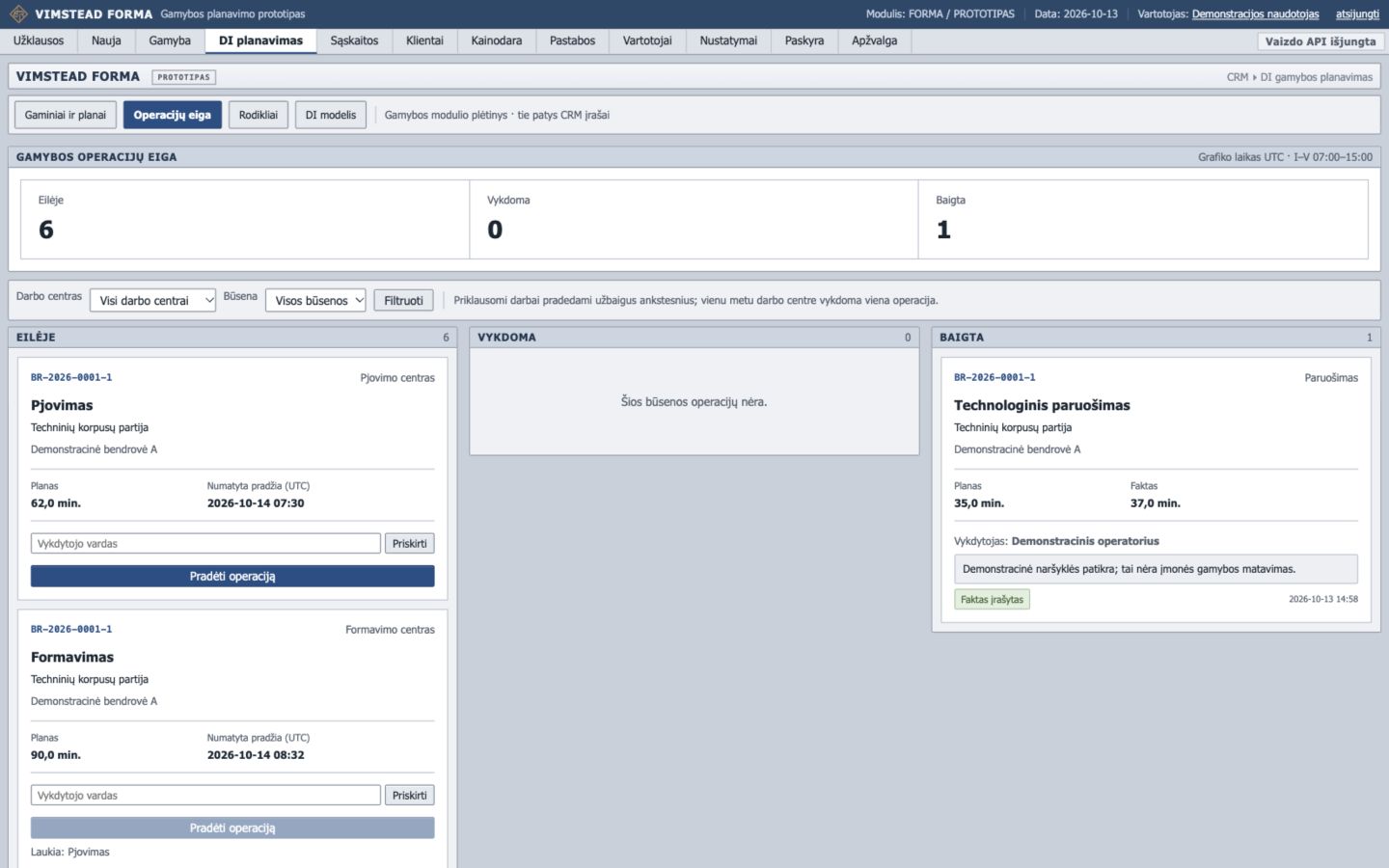
01 / The work Forma connects
Planning and production share the same order history
For the planner
Turn item information into an operation plan, review AI duration estimates and assign work for execution.
For the person doing the work
See the operation, update its progress and record actual time and notes against the same item.
For the manager
Compare the plan with completed work and identify where estimates or initial information need to improve.
02 / Product tour
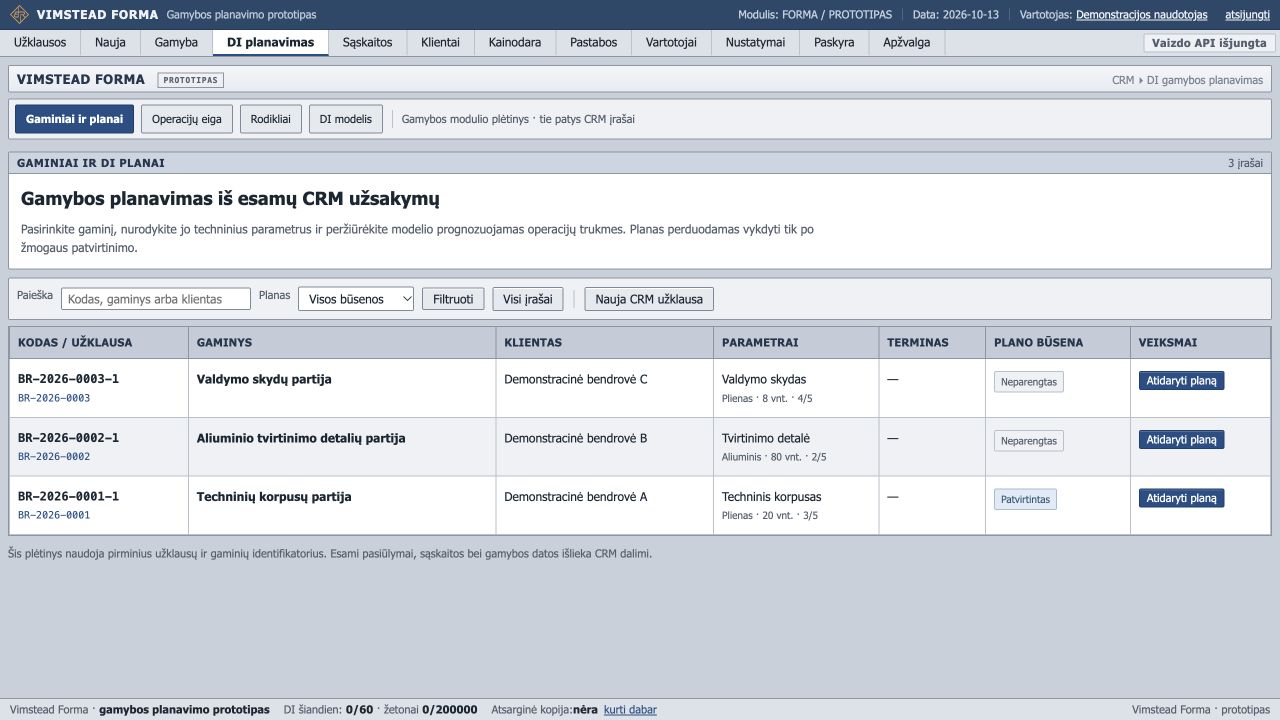
Follow one order from planning to actual time
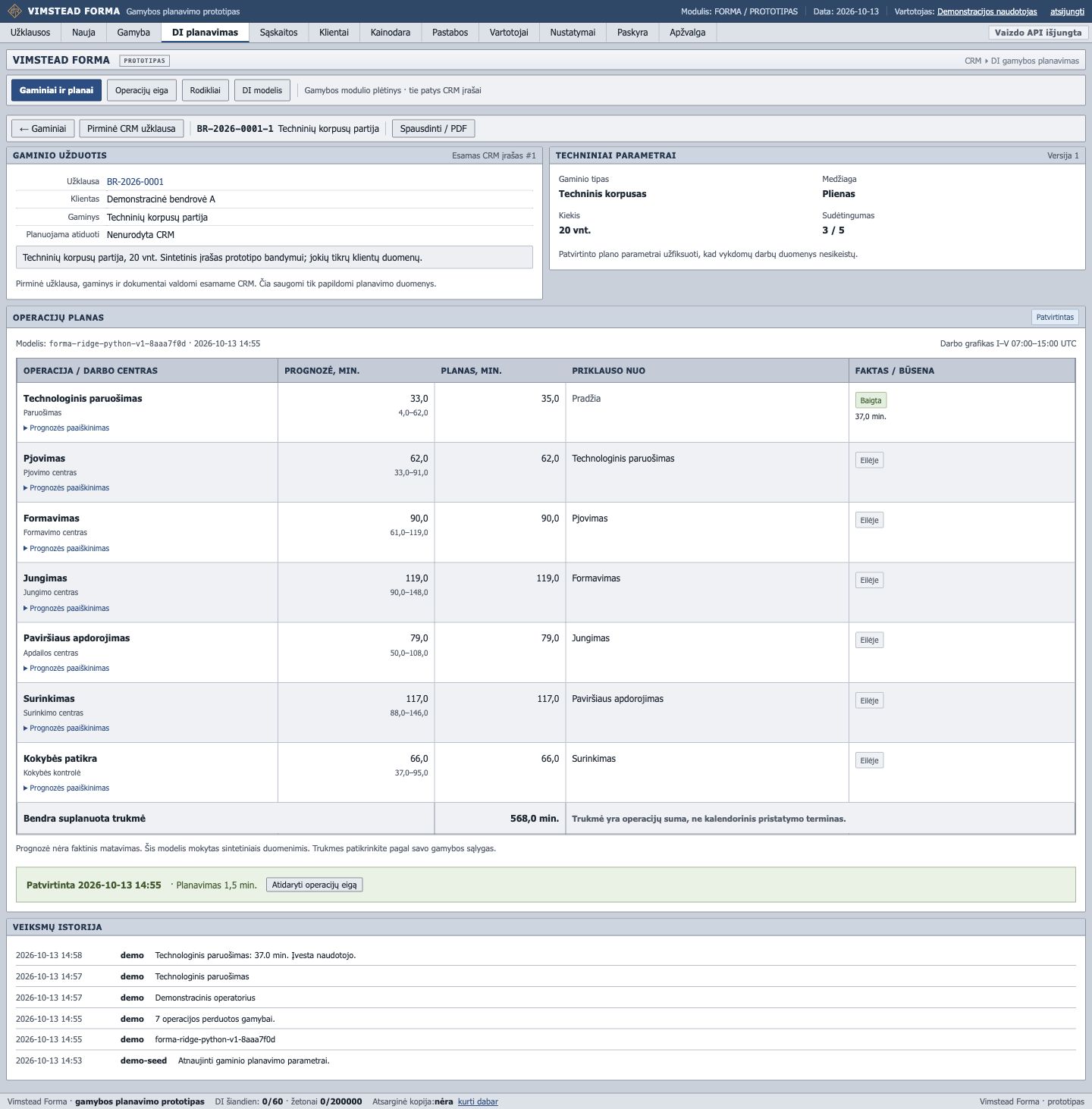
In this example, the system estimates 33 minutes for preparation. The planner approves 35 minutes, and the completed job is recorded at 37. All three times stay with the same operation, making it possible to compare the estimate, the plan and the actual duration.
01
Select the item
Order and item identifiers stay connected to the customer, quotation and documents.
02
Review and approve the plan
Item parameters, predicted time, the planner’s correction and operation dependencies appear in one plan.
03
Record the completed work
Operation status, the assigned person, actual minutes and notes add to the same work history.
The screens use sample records from version 0.1.0. The 33, 35 and 37 minute example shows how the model estimate, planner-approved duration and actual time remain attached to one operation.
03 / A defined AI task
AI estimates duration; a person approves the production plan
The model learns from operation records and estimates duration using item type, material, quantity and complexity. Separate rules determine the operation route and work-centre schedule.
01
Item information
Type, material, quantity and complexity.
02
Duration estimate
An estimated duration based on item information.
03
Human review
Checked and adjusted operation times.
04
Production action
Approved operations, progress and actuals.
Initial training uses sample data. Before applying the model in a business, predictions need to be checked against measurements of real work. Checked actual durations can then be used to retrain it.
04 / Reporting from the workplace
Completed work could be recorded with a voice update
We are planning a phone interface where a worker could report the quantity completed, time spent and materials used. Forma would turn that report into a work record for the person to review and confirm against the task.
01
Choose the relevant task
In this example, the update belongs to the assembly operation for order F-024. Quantity, time and notes all refer to the same piece of work.
02
Organise the voice update
The worker describes completed enclosures, time spent, screws used and a damaged cover. The example alongside shows that information organised into separate record fields.
03
Review before confirming
Before confirming, the worker would check quantities and units and correct any recognition errors. The confirmed information would become part of the order’s work history.
This approach would let people capture details at the workplace while they are fresh. The planner could see what is complete and which issue needs to be resolved before work continues.
VIMSTEAD FORMA
Order F-024 / Assembly
“Finished twelve enclosures in forty-five minutes. Used twenty-four screws. One enclosure needs a replacement for a damaged cover.”
Review before confirmation
- Completed
- 12 units
- Actual time
- 45 minutes
- Material
- 24 screws
- Issue
- Damaged cover — 1 unit
- Status
- Awaiting worker confirmation
05 / Product scope and documentation
What you can try now and what we plan to add
0.1.0
Working in prototype 0.1.0
- CRM enquiries, items, quotations and PDFs
- AI duration estimates and plan approval
- Operation dependencies and work-centre capacity
- Assignments, status, actual time and notes
- Measurement imports and model retraining
Roadmap
Planned extensions
- Employee phone workspace and voice updates
- Structured material consumption
- Operation photos, issues and rework
- Detailed employee permissions and shifts
- Connections to company inventory and accounting
What technology and existing systems does it use?
Forma uses Python, Flask, Jinja and SQLite. Production plans and operations connect to CRM enquiries, items and documents. A demonstration shows the workflow; deployment planning covers hosting, user access, backups and expected load.
Which data does it need?
Item parameters, operation routes, work centres and checked actual durations. Measurements can be imported as CSV. This version plans from structured records; creating a production plan from photographs or free text would require a separate development stage.
How will the benefit be evaluated?
Before a pilot, establish how long it takes to prepare a plan, how often substantial changes are needed and how planned operation times differ from actuals. Compare the same measures using the same method after the trial. That shows where the software helps and where it needs adjustment.
What needs review before deployment?
Version 0.1.0 uses example operation routes, a simplified work-centre calendar and a model trained on sample data. Deployment requires adapting these to real shifts, capacity and items, then checking predictions against the business’s own measurements.
The specification covers purpose, version, capabilities, AI inputs and outputs, integration, technical limits and readiness. Updated 2026-10-13.
06 / Implementation and acquisition
Scope implementation around the operations and data you actually use
Review the process and data
Walk through a representative order, its operations, the current planning method and available measurements of actual durations.
Define the adaptation
Agree the required integrations, planning rules and preparation of the model using the business’s records.
Plan the trial and handover
Set acceptance criteria, a comparable trial, staff training and the ongoing support arrangement.

Pricing follows the licence and implementation scope
A proposal distinguishes usage rights, adaptation, deployment, training and support. Hosting and external AI service costs are identified separately.
We start with a demonstration of prototype 0.1.0 and a discussion of your planning process. After assessing the changes required, we prepare a proposal covering implementation, usage terms and pricing.
Product developer: Vimstead, MB · Company code 304710068 · info@vimstead.com